
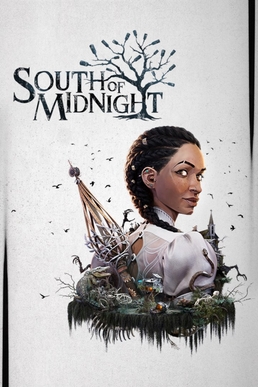
I’m SavageViper, a long-time casual gamer who’s seen everything from indie experiments to massive AAA releases, South of Midnight immediately stood out to me as something that isn’t just another action-adventure game—it’s trying to be a modern Southern Gothic folktale you actually play.
Developed by Compulsion Games and published by Xbox Game Studios, South of Midnight is a third-person action-adventure fantasy set in the American Deep South. It leans heavily into atmosphere, storytelling, and myth, wrapping everything in a hand-crafted visual style that feels intentionally artistic rather than hyper-realistic.
A Southern Gothic World That Feels Alive
One of the strongest aspects of South of Midnight is its setting. The game takes place in the fictional town of Prospero, a decayed yet strangely beautiful Southern landscape shaped by folklore, memory, and tragedy. After a hurricane devastates the town, the story follows Hazel, who is drawn into a surreal world where myths and emotional trauma become physical reality.
This is where the game really shines. The “Southern Gothic” tone isn’t just window dressing—it’s the foundation of everything. The environments feel heavy with history, loss, and mystery. You’re not just passing through levels; you’re walking through a living folktale.
Hazel and the Role of the Weaver
You play as Hazel, a protagonist who becomes a “Weaver,” a magical mender of broken bonds and spirits. This concept is honestly one of the most interesting parts of the game. Instead of just defeating enemies, Hazel’s role involves confronting emotional and mythical corruption and restoring what has been broken.
The gameplay revolves around using weaving-based abilities to fight “Haints” (supernatural creatures tied to pain and trauma), explore different regions of the South, and uncover the deeper story of Hazel’s family and identity.
From a casual player’s perspective, this gives the game a slightly different rhythm compared to typical action games—it’s less about constant combat chaos and more about meaningful encounters tied to story progression.
Storytelling and Emotional Weight
The narrative leans heavily into family, legacy, identity, and generational trauma. Hazel’s journey isn’t just about saving her mother or her hometown—it’s about understanding the emotional weight of where she comes from.
What I appreciated as a player is that the game doesn’t rush this. It takes its time to build mood and meaning, letting the Southern folklore and character-driven storytelling breathe.
What Works Really Well 👍
- Visual Style: The hand-crafted art direction is easily one of the standout features. It doesn’t try to look like every other AAA game—it commits fully to its own aesthetic identity.
- Atmosphere: The Southern Gothic setting is rich, eerie, and memorable. Prospero feels like a place with history layered into every corner.
- Music & Audio: The soundtrack and audio design are clearly built to enhance immersion, drawing from the cultural and emotional tone of the South.
- Concept & Story Premise: A hurricane-ravaged town, mythological creatures, and a magical “Weaver” protagonist is a strong foundation for a narrative-driven experience.
Where It Might Not Click for Everyone 👎
- Pacing: The game’s focus on storytelling and atmosphere may feel slow for players expecting constant action.
- Gameplay Depth (Based on what’s shown): While the weaving combat system is interesting conceptually, it may not appeal to players looking for deep mechanical complexity or fast-paced combat loops.
- Niche Tone: The heavy Southern Gothic folklore and emotional themes are unique—but not necessarily mainstream-friendly for every gamer.
Final Thoughts from SavageViper
From my perspective, South of Midnight feels like one of those games that is less about chasing trends and more about telling a specific kind of story in a very intentional way. It’s not trying to be a blockbuster action shooter or a massive open-world grind—it’s aiming to be a narrative-driven Southern Gothic fantasy experience with heart, style, and emotional depth.
If you’re someone who enjoys atmospheric storytelling, folklore-inspired worlds, and character-driven adventures, this is absolutely a game worth keeping an eye on.
But if you’re looking for fast-paced combat, heavy systems, or endless sandbox gameplay, this might feel more like a slow-burning experience than a traditional action-heavy title.
Either way, South of Midnight stands out in a crowded industry simply because it’s willing to be different—and that alone makes it worth talking about.

